A year ago today, I was on Everest putting in effort.
Not the flag-waving, summit-photo kind of effort. The quieter kind. Moving slowly, trying not to overcook myself, and paying attention to what my body was telling me.
Today, I share a slightly longer personal reflection on Everest with you. The point is simple: sometimes summit success is shaped much earlier than we think.
During this expedition, I used Polarsteps to keep an online diary. This meant I could type a few notes in the moment, lying in my tent while my journal was down in Base Camp. A year later, those little entries have become more than memories. They are breadcrumbs.
On 6 May 2025, I wrote:
“Taking 6:35 from C2 to C3, I was happy in the beginning of the slog, but the deterioration of my pace once over 6900m did get me a little worried, but I kept going slowly, not wanting to overexert myself. This approach seems to have paid off as I'm not feeling bad at all.”
At the time, it was just a field note. A tired person’s record of a long day.
With hindsight, I now think that day was one of the most important days in my entire expedition.
In 2024, I touched the bergschrund below Camp 3. In 2025, I slept at Camp 3 during my rotation. That difference sounds small on paper. In reality, it was not small at all.
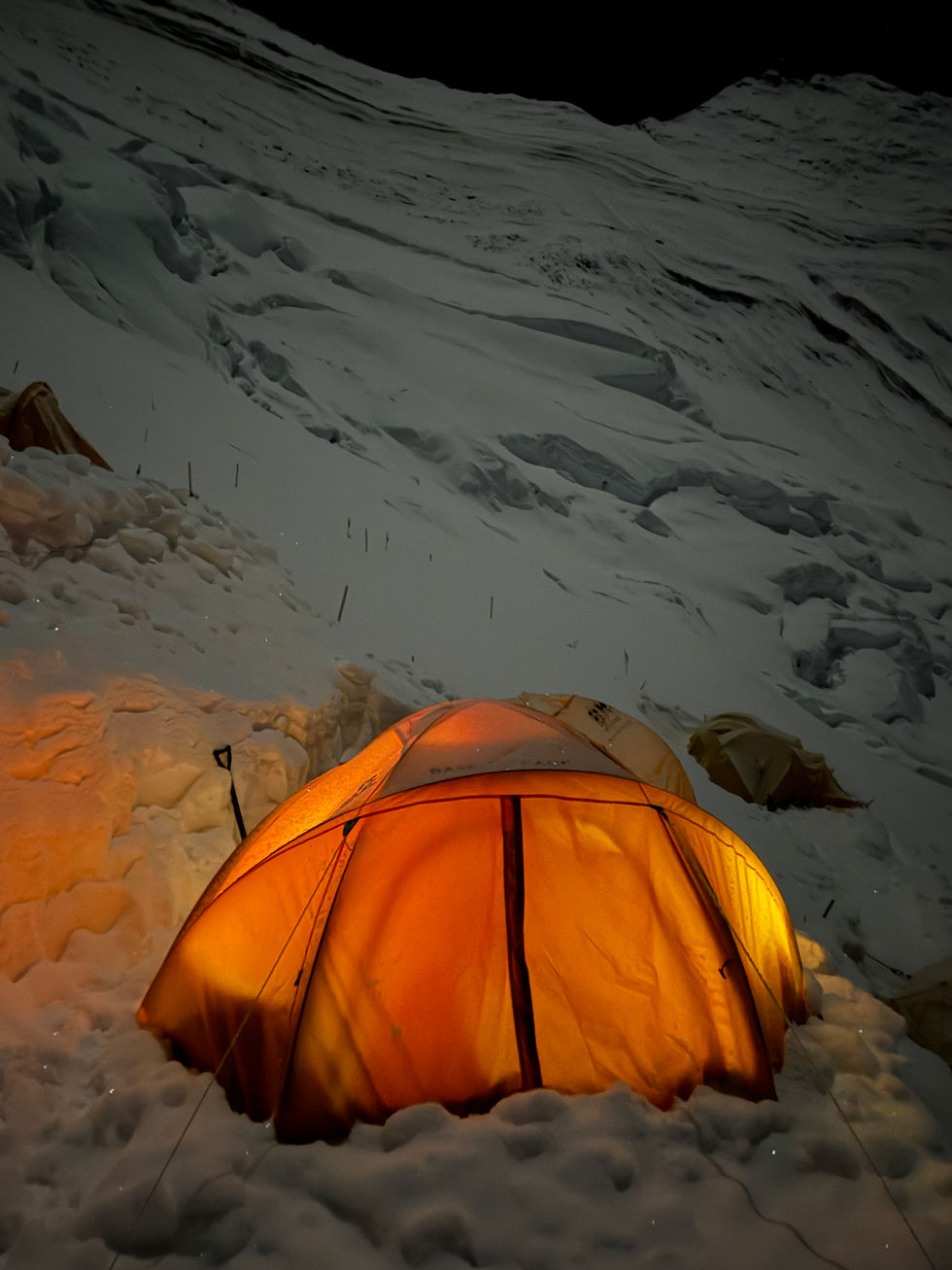
Camp 3 sits high on the Lhotse Face, where the air is thin enough that your body complains more than usual.
The 2024 approach is what most people do: climb high, touch somewhere near or below Camp 3, then return. The 2025 approach was old-school. Slower. More laborious and time-consuming. But also, I think, more useful.
On the night of 6 May, I slept at Camp 3.
A few days later, the rotation ended back at Base Camp. Then, when I returned to Camp 3 on the summit push, something quite extraordinary happened.
In the morning, I left Camp 3 for Camp 4, and my WHOOP recovery was green.
Green. At Camp 3. Halfway up the Lhotse Face. Before moving into the death zone.
I still find that remarkable.
With the help of the AI analysis in my WHOOP app, I have since looked more closely at the year-on-year comparison. The difference between touching high and actually sleeping high showed up in the data and in how I felt. My body was not just surviving the rotation. It had adapted enough to be ready for the next step.
I later learnt from Billy at the Himalayan Database that only about three climbers, out of the hundreds on the mountain last year, actually slept at Camp 3 during rotation.
That stopped me.
Because in many ways, this is such an available insurance policy: a practical, physiological, old-school acclimatisation investment.
It does take time. It takes effort. It adds another hard night to an already hard expedition. It can feel excessive when everyone else is doing less and still hoping for the same result.
But this is where Everest often gets interesting. Not in the big moments everyone talks about, but in the small decisions made earlier. The ones that do not look decisive at the time.I am watching this year’s Everest season play out with the strange mixture of distance, experience and hindsight. I do notice who is rushing. I notice who is doing the patient work. And yes, I will also be watching for a rare night at Camp 3.
Especially for older climbers, I think this matters. The mountain does not care how much we want the summit. But the body does respond to good preparation and patient acclimatisation.
It is easy to look at a summit and think success happens near the top. I know first-hand that it is decided much earlier.
Often, success is decided on a slow, six-and-a-half-hour climb from Camp 2 to Camp 3, when you choose not to panic, not to push too hard, and simply keep going.
Slowly.



Comments